



What Makes the Best All-Natural Toothpaste? A Criteria-Based Guide
Not all natural toothpastes are created equal. Here's why.

Not all natural toothpastes are created equal. Here's why.


Here are the five criteria to evaluate any formula on its actual merits — all verifiable before you buy:
● Verified free-from list — fluoride-free, SLS-free, paraben-free, and free from artificial colors and sweeteners, confirmed on the ingredient label — not just in marketing copy
● Named plant-based actives — every botanical identified with its specific oral health role; "natural flavors" with no further detail is not transparency
● Quality certifications — GMP-certified manufacturing, clinical testing, and heavy-metal testing confirm a measurable production standard, not just a clean-sounding label
● Dentist recommendation — on the specific product label, not a general category endorsement; a meaningfully higher bar
● Formulation tradition — over 35 years of R&D signals ingredient choices made within a consistent philosophical framework, not assembled to fit a trend
Ayurveda has used Neem and Clove for oral health for thousands of years — not as folklore, but as botanical medicine whose active compounds are now the subject of ongoing dental research.
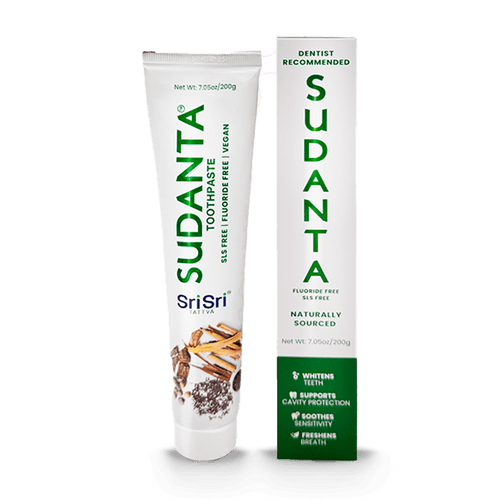
Triphala, the three-fruit classical blend, has a long history of use in Ayurvedic oral care for gum tissue support and microbiome balance — part of the broader tradition that informs formulations like Sudanta.
Sri Sri Tattva brings GMP-certified manufacturing to that tradition — a level of production rigor that most herbal oral care brands, traditional or modern, do not publish or apply.
Effectiveness in a natural toothpaste comes from two things working together: verified active ingredients with documented oral health applications, and consistent manufacturing quality.
● Verified active ingredients with documented oral health roles — antibacterial botanicals such as Neem and Clove are among the most researched in the Ayurvedic oral care tradition, with active compounds that target plaque-forming bacteria and gum inflammation.
● GMP-certified production confirms that formulation standards are met batch to batch — not just in a single tested sample.
● A dentist’s recommendation on the specific product label, rather than a general endorsement of the natural toothpaste category, adds a further layer of third-party validation.
● Taken together, these markers distinguish a genuinely effective natural toothpaste from one that relies on front-of-pack claims without a production standard to back them.
Natural toothpaste is a broad, unregulated category — any brand can use the label without meeting a defined ingredient standard, production requirement, or formulation philosophy.
● Natural toothpaste: no defined standard, no required formulation philosophy, no mandated ingredient criteria.
● Ayurvedic toothpaste: a structured botanical tradition using named herbs — Neem, Clove, Triphala — with thousands of years of documented oral-health applications and a consistent philosophical framework governing ingredient selection.
● The distinction is not only which herbs are used, but why they were chosen and how the formula is understood to work.
● When backed by GMP-certified manufacturing and clinical testing, Ayurvedic toothpaste is the best all-natural option for those who want both tradition and verified modern quality standards.
Charcoal toothpaste safety depends entirely on the formulation — the key question is not whether the product contains charcoal, but how it is used within the formula.
● Activated charcoal used as a primary abrasive whitening agent can damage tooth enamel with repeated daily use — dental professionals and multiple oral health studies have flagged this concern, particularly for high-abrasion formulas.
● Sudanta Charcoal is formulated as a non-abrasive Ayurvedic herbal toothpaste — SLS-free and paraben-free — in which charcoal is one component of a broader botanical blend rather than the primary whitening mechanism.
● For personalized guidance on daily charcoal toothpaste use relative to your enamel health, consult your dentist.